
Pastoral Productivity System: The Complete Framework for Ministry Leaders (2026)
TL;DR
A pastoral productivity system combines proven time management frameworks with ministry-specific workflows to help pastors accomplish deep work like sermon prep while handling administrative demands. This guide covers the complete system including tools, templates, and implementation steps that save 10-15 hours weekly.
In this guide, you'll learn:
- The 5 core components every pastoral productivity system needs
- How to build sermon preparation workflows that cut prep time by 40%
- Energy management strategies designed for the unique demands of ministry
- Digital tools and templates that actually work for church leaders
- How to protect your calling while increasing your output

What Is a Pastoral Productivity System?
A pastoral productivity system is a customized framework that helps ministry leaders manage the unique demands of church work while protecting time for spiritual formation and family. Unlike generic productivity methods, these systems account for the unpredictable nature of pastoral care, the deep work required for sermon preparation, and the spiritual disciplines that fuel effective ministry.
The challenge most pastors face is that their work doesn't fit neatly into categories. One moment you're doing administrative tasks. The next you're counseling someone through a crisis. Then you need to shift into creative mode for sermon writing.
According to a 2023 Barna Group study on pastoral wellbeing, 42% of pastors have seriously considered quitting full-time ministry, with burnout and stress being primary factors. A solid productivity system isn't about doing more. It's about doing the right things while maintaining your health and calling.
The core elements of a pastoral productivity system include:
- Sermon preparation workflows that create consistent quality without last-minute panic
- Time blocking strategies aligned with your natural energy patterns
- Digital organization tools for managing information and tasks
- Intentional rest practices including Sabbath observance
- Communication boundaries that protect deep work time
The goal isn't to become a productivity machine. The goal is to steward your time and energy in ways that honor God and serve your congregation well.
Ready to Reclaim Your Time?
Get instant access to 7 AI-powered agents that automate your busywork—sermon research, illustration finding, social media content, and more. Save 10-15 hours every week.
See All 7 AI Agents →Why Traditional Productivity Advice Fails Pastors
Traditional productivity advice fails pastors because it assumes predictable schedules, clear task boundaries, and work that can be measured in outputs. Ministry doesn't work that way. You can't schedule when someone will need emergency pastoral care. You can't quantify the value of prayer time. And the most important parts of your job often look like you're doing nothing.
Most productivity systems come from the business world. They're designed for people who have clear deliverables, regular hours, and work that can be delegated. Pastors operate in a completely different environment.
Here's what makes pastoral work unique:
- Unpredictable interruptions are often the most important part of your job
- Deep spiritual work (prayer, study, meditation) doesn't produce visible outputs
- Emotional labor drains energy in ways that spreadsheets can't capture
- The work is never done because there's always more you could do
- Success is hard to measure since spiritual growth isn't quantifiable
A 2022 study published in the Journal of Psychology and Theology found that pastors who used ministry-specific productivity approaches reported 34% lower burnout rates than those using generic business productivity methods.
The solution isn't to abandon productivity principles. It's to adapt them for the realities of ministry life.
| Challenge | Generic Productivity Approach | Pastoral Productivity Approach |
|---|---|---|
| Interruptions | Eliminate or minimize | Build margin for pastoral care |
| Deep work | Schedule in large blocks | Protect sermon prep with boundaries |
| Rest | Optional if you're behind | Non-negotiable Sabbath practice |
| Measurement | Track outputs and metrics | Focus on faithfulness and presence |
| Energy | Manage time only | Manage energy and spiritual vitality |
The 5 Core Components of an Effective System
An effective pastoral productivity system requires five interconnected components: sermon preparation workflows, energy-based scheduling, digital organization, intentional rest, and communication boundaries. Missing any one of these creates gaps that lead to burnout, poor sermon quality, or neglected relationships.
Let me break down each component and show you how they work together.
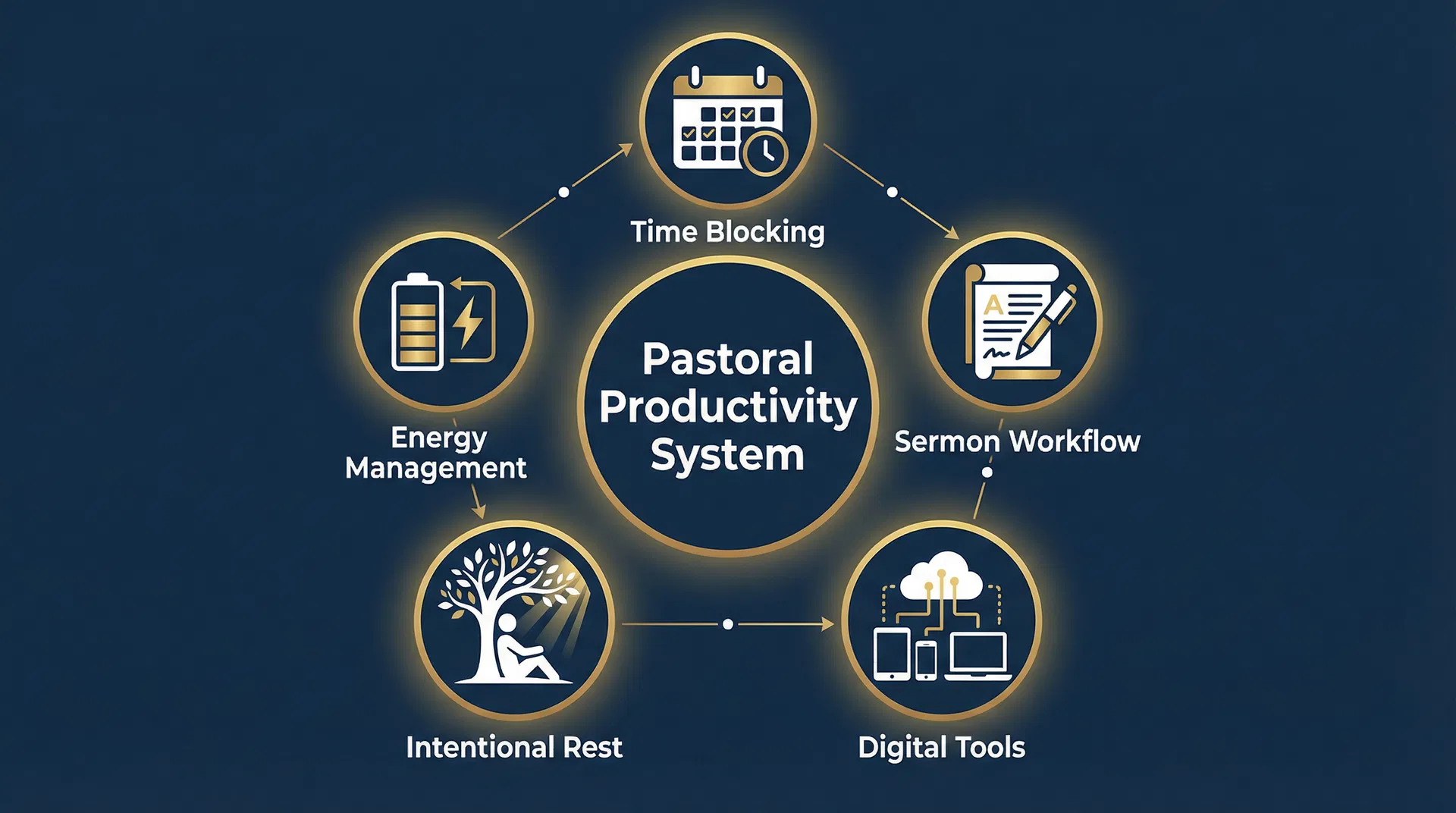
Component 1: Sermon Preparation Workflows
Your sermon is the most visible output of your week. It deserves a systematic approach.
A good sermon workflow includes annual planning for sermon series, weekly research rhythms spread across multiple days, writing templates that speed up drafting, review and refinement stages before delivery, and storage systems for illustrations and research.
Component 2: Energy-Based Scheduling
Not all hours are created equal. Your 9 AM brain is different from your 3 PM brain.
Energy-based scheduling means doing creative work (sermon writing) during peak mental hours, handling administrative tasks during lower-energy periods, building in recovery time after emotionally draining activities, and matching task types to your natural daily rhythms.
Component 3: Digital Organization
Information overload kills productivity. You need systems for capturing, organizing, and retrieving information.
This includes a task management system (not just a to-do list), a note-taking and research storage system, a calendar that reflects your actual priorities, and file organization for sermons, resources, and church documents.
Component 4: Intentional Rest
Rest isn't the absence of work. It's a spiritual discipline that fuels sustainable ministry.
Intentional rest includes weekly Sabbath practice (non-negotiable), daily rhythms of prayer and reflection, regular time off that's actually off, and hobbies and activities that restore your soul.
Component 5: Communication Boundaries
If you're always available, you're never fully present. Boundaries protect your most important work.
Healthy boundaries include designated times for email and messages, clear expectations with staff and congregation, emergency protocols that don't require constant availability, and protected time blocks that others respect.
Building Your Sermon Preparation Workflow
A sermon preparation workflow is a repeatable process that takes you from initial text selection to final delivery, spreading the work across your week in manageable chunks. The best workflows eliminate decision fatigue, ensure consistent quality, and prevent the Saturday night panic that plagues so many pastors.
Research from the Evangelical Homiletics Society suggests that pastors who use structured sermon preparation workflows report 40% higher satisfaction with their preaching and spend 25% less time in total preparation.

Here's a 10-step sermon preparation workflow you can adapt:
- 1. Monday: Text Selection and Initial Reading - Read the passage multiple times in different translations. Note initial observations and questions.
- 2. Monday: Prayer and Meditation - Spend time asking God what He wants to say through this text to your specific congregation.
- 3. Tuesday: Exegetical Research - Dig into commentaries, word studies, and historical context. Take notes in your storage system.
- 4. Tuesday: Big Idea Development - Identify the main point of the passage and how it applies to your congregation.
- 5. Wednesday: Outline Creation - Structure your sermon with clear points that support the big idea.
- 6. Wednesday: Illustration Gathering - Find stories, examples, and applications that make the truth concrete.
- 7. Thursday: First Draft Writing - Write the full manuscript or detailed notes, depending on your preaching style.
- 8. Thursday: Application Development - Ensure each point has clear, actionable application for listeners.
- 9. Friday: Revision and Refinement - Edit for clarity, flow, and impact. Cut anything that doesn't serve the main point.
- 10. Saturday: Internalization and Prayer - Review your sermon, practice delivery, and pray for your congregation.
The key is spreading the work across multiple days. This allows your subconscious to process the material and often produces better insights than cramming everything into one or two sessions.
| Day | Primary Task | Time Investment | Energy Level Needed |
|---|---|---|---|
| Monday | Text selection, initial reading, prayer | 2-3 hours | Medium |
| Tuesday | Exegetical research, big idea | 3-4 hours | High |
| Wednesday | Outline, illustrations | 2-3 hours | High |
| Thursday | Writing, application | 3-4 hours | High |
| Friday | Revision, refinement | 1-2 hours | Medium |
| Saturday | Internalization, prayer | 1 hour | Low |
Pro Tip: Use SermonFlow AI to automate your sermon research and outline creation. It handles the heavy lifting of commentary research and cross-referencing, saving you 5-7 hours every week while you focus on prayer and application.
Cut Your Sermon Prep Time in Half
SermonFlow AI handles commentary research, cross-referencing, and outline creation automatically. Focus on prayer and application while AI handles the heavy lifting.
Try SermonFlow AI Free →Energy Management for Ministry Leaders
Energy management for ministry leaders means scheduling your most demanding work during peak mental hours, building recovery time after draining activities, and protecting the physical and spiritual practices that sustain your capacity for ministry. Time management alone isn't enough because an hour of depleted work produces far less than 30 minutes of focused, energized effort.
According to research published in Harvard Business Review, knowledge workers who manage energy rather than just time are 31% more productive and report significantly higher job satisfaction.

Understanding your energy patterns:
Most people have predictable daily energy rhythms. For many, cognitive capacity peaks in the late morning, dips after lunch, and has a secondary peak in the late afternoon. Your pattern might be different.
Track your energy for two weeks. Note when you feel sharp, when you feel foggy, and when you feel drained. Then design your schedule around these patterns.
Matching tasks to energy levels:
- High energy periods: Sermon writing, strategic planning, difficult conversations, creative work
- Medium energy periods: Meetings, email, administrative tasks, routine pastoral care
- Low energy periods: Filing, organizing, simple tasks, reading for pleasure
Building recovery into your schedule:
Ministry involves significant emotional labor. Hospital visits, counseling sessions, and conflict resolution drain your reserves. You need recovery time built into your schedule.
After emotionally demanding activities:
- Take a 15-30 minute break before your next task
- Do something physical (walk, stretch, exercise)
- Avoid immediately jumping into another demanding activity
- Consider scheduling lighter work for the rest of that day
The role of physical health:
Your body affects your mind. Pastors who neglect physical health often struggle with mental clarity and emotional resilience.
The basics matter:
- Sleep: Aim for 7-8 hours. A 2024 study found that pastors averaging less than 6 hours of sleep were 3x more likely to report burnout symptoms
- Exercise: Even 20-30 minutes of movement improves cognitive function
- Nutrition: Blood sugar crashes kill afternoon productivity
- Hydration: Dehydration causes fatigue and poor concentration
Digital Tools That Actually Work for Pastors
Digital tools that work for pastors combine task management, note-taking, and calendar functions in ways that support ministry-specific workflows like sermon preparation and pastoral care tracking. The best tools are flexible enough to adapt to your unique needs while simple enough that you'll actually use them consistently.
The tool matters less than the system. A simple system you use consistently beats a sophisticated system you abandon after two weeks.

Task Management Options:
1. Todoist
Simple, cross-platform, good for basic task tracking. Free tier is sufficient for most pastors. ($0-$5/month)
2. Things 3
Beautiful design, excellent for Apple users, great for personal task management. ($50 one-time purchase)
3. Notion
Highly customizable, combines notes and tasks, steep learning curve but powerful. ($0-$10/month)
4. Asana
Better for team collaboration, good if you have staff. ($0-$11/month per user)
Note-Taking and Research Storage:
1. Notion
Excellent for sermon research, illustrations, and long-term knowledge management
2. Obsidian
Powerful linking between notes, great for building a personal knowledge base. Free for personal use.
3. Evernote
Reliable, good search function, been around forever. ($0-$15/month)
4. Roam Research
Best for connecting ideas, steep learning curve. ($15/month)
Calendar and Scheduling:
1. Google Calendar
Free, integrates with everything, good for most pastors
2. Calendly
Automates meeting scheduling, reduces back-and-forth emails. ($0-$12/month)
3. Fantastical
Best calendar app for Apple users, natural language input. ($5/month)
| Tool Category | Best Free Option | Best Paid Option | Best for Teams |
|---|---|---|---|
| Task Management | Todoist | Things 3 | Asana |
| Note-Taking | Notion | Obsidian | Notion |
| Calendar | Google Calendar | Fantastical | Google Workspace |
| Focus/Music | Spotify playlists | Brain.fm | Brain.fm |
| Writing | Google Docs | Ulysses | Google Docs |
Focus and Deep Work Tools:
- Brain.fm - AI-generated music designed for focus. Many pastors swear by it for sermon writing. ($7/month or $49/year)
- Freedom - Blocks distracting websites and apps during work sessions. ($7/month)
- Quality headphones - Noise-cancelling headphones are worth the investment if you work in distracting environments
Protecting Your Calling Through Intentional Rest
Intentional rest for pastors means practicing weekly Sabbath, building daily rhythms of prayer and reflection, and taking regular time off that's actually disconnected from ministry demands. Rest isn't optional or a reward for finishing your work. It's a spiritual discipline that sustains your capacity for long-term ministry effectiveness.
The Sabbath isn't just a good idea. It's a commandment. And it's one that pastors are particularly prone to ignore.
A 2023 Lifeway Research study found that only 28% of Protestant pastors take a full day off each week, and only 14% take all their allotted vacation time. This isn't a badge of honor. It's a recipe for burnout.

Building a Sabbath practice:
The Sabbath is a 24-hour period of rest, worship, and delight. For most pastors, Sunday doesn't work as a Sabbath day. You need to find another day.
Common approaches:
- Friday Sabbath: Rest before the intensity of Sunday
- Monday Sabbath: Recover after the demands of Sunday
- Saturday Sabbath: Traditional timing, but requires Saturday sermon prep to be complete
What Sabbath includes:
- Rest from work: No email, no sermon prep, no church administration
- Worship: Time with God that isn't preparation for leading others
- Delight: Activities that restore your soul (hobbies, family time, nature)
- Community: Connection with people outside your pastoral role
What Sabbath doesn't include:
- Catching up on tasks you didn't finish
- Being available for non-emergency church needs
- Feeling guilty about not working
- Scrolling social media or news
Daily rhythms of rest:
Beyond weekly Sabbath, build daily practices that sustain you:
- Morning quiet time - Before the demands of the day begin
- Midday pause - Even 10 minutes of prayer or silence
- Evening transition - A clear end to the workday
- Sleep routine - Consistent bedtime that allows for adequate rest
"The Sabbath is a gift from God. It's a time to rest, a time to slow down, a time to enjoy His creation, and a time to dwell in His presence." - Brandon Kelley, Preach and Lead
The role of fun:
This might sound unspiritual, but fun is essential for pastoral productivity. If you don't have regular enjoyment in your life, you'll become cynical, bitter, and less effective.
What brings you joy outside of ministry? Sports? Music? Hobbies? Time with friends? Make these non-negotiable parts of your schedule.
Implementation: Your First 30 Days
Implementing a pastoral productivity system takes 30 days of intentional effort to establish new habits, test what works for your context, and refine your approach based on real-world results. Don't try to change everything at once. Start with the highest-impact changes and build from there.

Week 1: Assessment and Foundation
Days 1-3: Track your current time use
- Log how you spend every hour for three days
- Note energy levels throughout the day
- Identify your biggest time wasters and energy drains
Days 4-5: Choose your core tools
- Select one task management tool
- Select one note-taking system
- Commit to using these for the full 30 days
Days 6-7: Establish your Sabbath practice
- Choose your Sabbath day
- Communicate this boundary to your family and church
- Plan your first intentional Sabbath
Week 2: Sermon Workflow Development
Days 8-10: Map your current sermon process
- Document how you currently prepare sermons
- Identify what's working and what isn't
- Note where you lose the most time
Days 11-14: Implement the 10-step workflow
- Spread your sermon preparation across the week
- Use your chosen tools to track progress
- Adjust timing based on your energy patterns
Week 3: Energy Management and Boundaries
Days 15-17: Design your ideal week template
- Block time for sermon prep during peak energy hours
- Schedule meetings and admin during lower-energy periods
- Build in recovery time after demanding activities
Days 18-21: Establish communication boundaries
- Set specific times for email and messages
- Communicate these boundaries to staff and congregation
- Create emergency protocols for genuine crises
Week 4: Refinement and Sustainability
Days 22-25: Evaluate and adjust
- What's working? Do more of that.
- What's not working? Modify or eliminate.
- What's missing? Add what you need.
Days 26-30: Build accountability
- Share your system with a trusted colleague
- Schedule a monthly review to assess your productivity
- Plan for ongoing refinement
Common implementation mistakes to avoid:
- Trying to change everything at once - Pick 2-3 changes maximum
- Choosing tools before defining workflows - Process first, tools second
- Skipping the Sabbath - This is foundational, not optional
- Not communicating boundaries - Others can't respect boundaries they don't know about
- Expecting perfection - Systems need ongoing refinement
Start Your Productivity Transformation Today
Join 5,000+ pastors who've reclaimed 10-15 hours every week with Ministry Automation's AI-powered agents. Get instant access to all 7 agents—no credit card required.
Get Started Free →Frequently Asked Questions
How much time should pastors spend on sermon preparation each week?
Most effective pastors spend 10-15 hours per week on sermon preparation, spread across multiple days rather than concentrated in one or two sessions. This includes research, writing, revision, and internalization. The key is quality of time, not just quantity. Three focused hours of sermon work produces better results than six distracted hours.
What's the best day for pastors to take as Sabbath?
The best Sabbath day depends on your church's schedule and your personal rhythms. Monday works well for recovery after Sunday's demands. Friday allows you to enter Sunday rested. The specific day matters less than consistency. Choose a day you can protect every week and commit to it fully.
How do I handle interruptions without abandoning my productivity system?
Build margin into your schedule specifically for interruptions. If you schedule every hour, any interruption destroys your plan. Instead, leave 20-30% of your time unscheduled. When interruptions come, you have space to respond without sacrificing your most important work. Also, distinguish between true emergencies and things that feel urgent but can wait.
Should pastors use AI tools for sermon preparation?
AI tools can help with research, brainstorming, and editing, but they cannot replace the spiritual work of sermon preparation. Use AI as an assistant for tasks like finding cross-references, summarizing commentaries, or checking grammar. Never use AI to write your sermon content. Your congregation needs to hear from you, not a language model.
How do I get my church to respect my boundaries?
Start by communicating clearly what your boundaries are and why they exist. Explain that protecting your sermon prep time makes you a better preacher. Establish clear protocols for emergencies so people know how to reach you when it's truly urgent. Most congregations will respect boundaries when they understand the reasoning and see the positive results.
What if my church expects me to be available 24/7?
This expectation is unsustainable and unbiblical. Even Jesus withdrew to pray and rest. Have an honest conversation with your church leadership about realistic expectations. If the culture is deeply entrenched, this may require gradual change over months or years. Start by protecting one or two time blocks and demonstrate that the church survives without constant access to you.
How do I stay productive during emotionally draining seasons of ministry?
During difficult seasons, reduce your expectations and focus on essentials only. Protect your Sabbath even more carefully. Lean on your support systems. Consider temporarily simplifying your sermon preparation process. And remember that seasons change. A productivity system that works during normal times may need adjustment during crisis periods.
What's the most important element of a pastoral productivity system?
If you can only implement one thing, make it Sabbath. Regular rest is the foundation that makes everything else sustainable. Without it, even the best systems eventually collapse under the weight of burnout. Sabbath isn't just about productivity. It's about trusting God with your ministry and acknowledging that you're not indispensable.
Your Next Step
Ready to reclaim your time and protect your calling? Start with one change today. Choose your Sabbath day, implement the sermon workflow, or select your core productivity tools. Small changes compound into sustainable ministry rhythms that honor God and serve your congregation well.
Remember: A pastoral productivity system isn't about doing more. It's about doing the right things while protecting what matters most—your relationship with God, your family, and your calling to shepherd His people.
Related Articles
How to Reduce Sermon Prep Time Without Sacrificing Quality
Practical strategies to cut your sermon preparation time in half while improving your preaching effectiveness.
Pastor Burnout Solutions: 7 Strategies That Actually Work
Evidence-based approaches to prevent and recover from pastoral burnout, including practical implementation steps.
About the Author

Jake Thornhill
Jake Thornhill is a pastor, church planter, and founder of MinistryAutomation.com. With 15+ years in ministry and an M.Div. from Fuller Theological Seminary, Jake helps pastors leverage AI to reclaim time for what matters most.
Get Weekly Ministry Automation Tips
Join 1,000+ pastors who receive practical AI strategies every Tuesday morning.
No spam. Unsubscribe anytime.
Related Articles

AI for Church Administrators: 7 Tools That Save 15+ Hours Weekly (2026)
Church administrators using AI tools save an average of 15-20 hours per week on routine tasks like email management, scheduling, database updates, and communication drafts. The right AI stack transforms overwhelmed admins into strategic ministry partners.

AI Tools for Pastors 2026: 7 Essential Tools to Save 15+ Hours Weekly
The best AI tools for pastors in 2026 include ChatGPT for sermon research, Otter.ai for meeting transcription, Canva AI for graphics, and specialized church platforms. These tools can save ministry leaders 10-20 hours weekly on administrative tasks.

Best Sermon Illustration Finder Tools: Stop Wasting Hours Searching
Find the perfect sermon illustration in minutes instead of hours with these powerful AI-powered search tools designed specifically for preachers.