How to Plan a Sermon Series Without Starting From Scratch Each Week
Ministry Automation makes and sells the prompt packs linked on this page.
Two practical ways to get started with AI in your ministry
Senior Pastor AI Prompt Pack
$6.99 · one-time purchase
Complete Church Staff AI Bundle
$24.99 one-time · all 7 role packs
How these pages are made | Tell us if something on this page is wrong
TL;DR: Before you write week 1, write the series in one sitting: a one-sentence thesis, a start and end date, a passage or theme for each week, a one-sentence aim for each week, and one midweek carry-over (a small-group question, a family practice, or a social post idea). Then each Sunday starts from that row, not from a blank page. Use the sermon outline template and the sermon research assistant for the weekly work. This page does not replace those guides.
What should you finish before you write the first sermon in a series?
You should finish a series map: the thesis, the number of weeks, the passage or theme for each week, the one thing you want people to understand or do that week, and one midweek carry-over. If you cannot fill those fields, you are not ready to outline week 1. You are still choosing the series.
A weekly outline is a different job. That work belongs on the sermon outline template page, and the step-by-step writing process is on how to write a sermon. This page stops at the map those pages need as input.
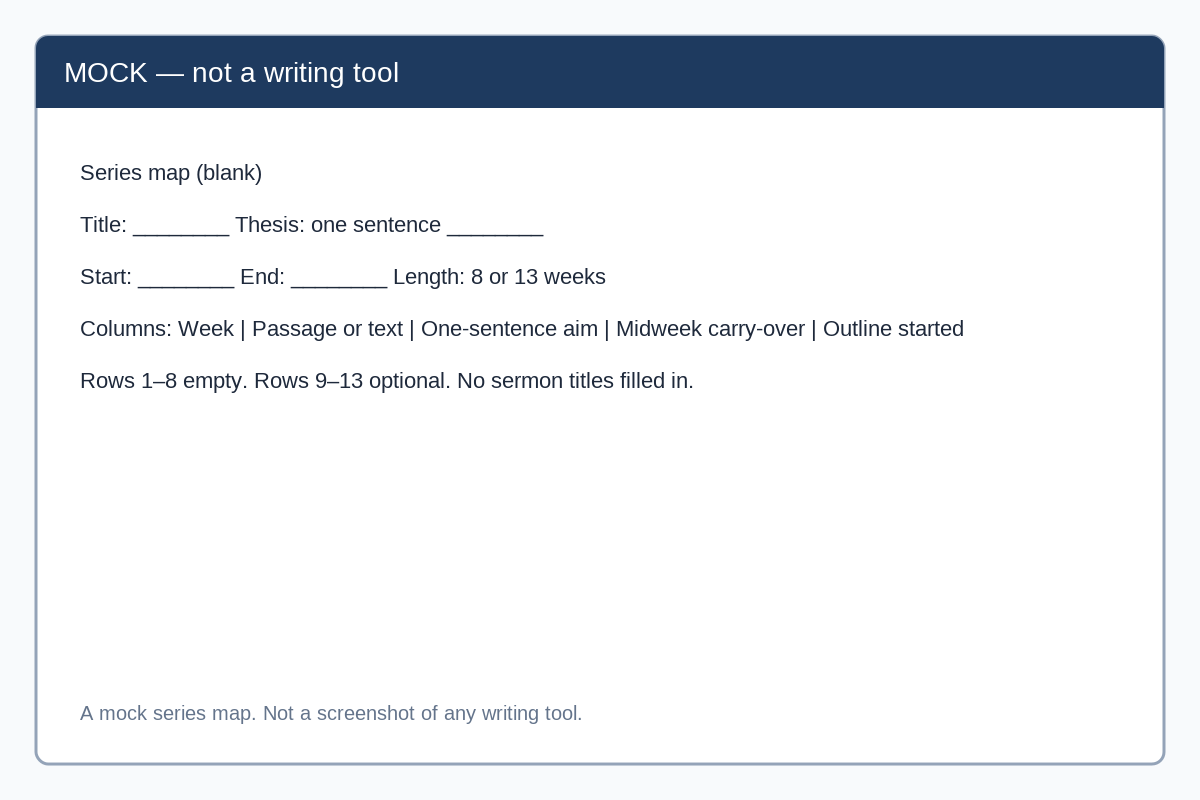
Should you plan 8 weeks or 13 weeks?
Plan 8 weeks if the series is a single book section, a short seasonal stretch, or the first time you have tried a written series map. Plan 13 weeks if you already know the arc (for example, a term that runs from the start of a school season to a break) and you can name a passage or aim for each week without padding.
The number is a planning choice, not a rule about attention spans. If week 9 would only repeat week 3, stop at 8 and start a new map. If you cut a 13-week map short, keep the unused rows. They often become the next series instead of leftover weeks you have to invent later.
What goes in each weekly row?
Fill five fields, in this order:
- Week and date. The Sunday, not the week you hope to start writing.
- Passage or text. A defined text, or a clearly bounded theme with the texts you will actually preach. "Grace" is not a passage. "Ephesians 2:1–10" is.
- One-sentence aim. What a listener should understand or do by the end of the service. If you need a paragraph, the week is still unfocused.
- Connection to the thesis. One short note on how this week serves the series sentence, so week 5 does not drift into a standalone talk.
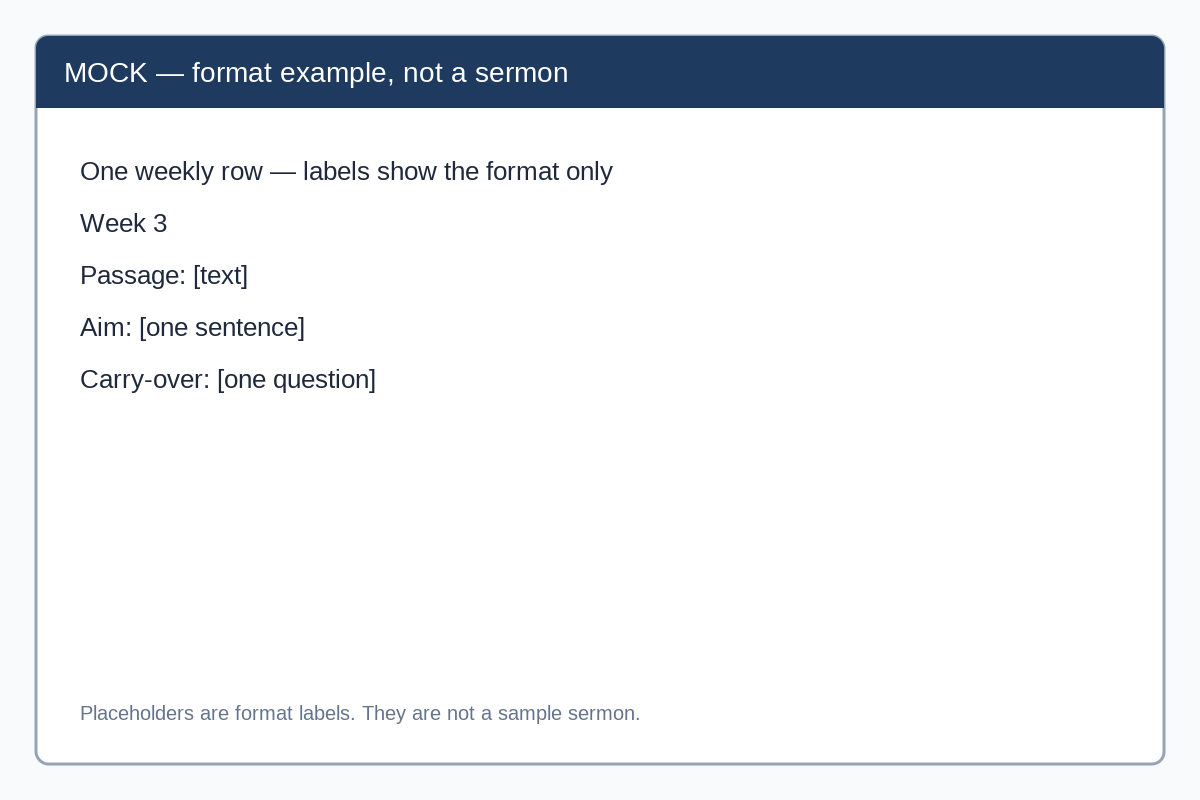
- Midweek carry-over. One item only: a discussion question, a household practice, or a single public post idea. More than one usually means none of them get used.
Leave a sixth column, "outline started," blank until the weekly outline exists. That column is a status check, not a writing space.
How do you research a week without rebuilding the series?
Once the map is done, each week has a defined text and aim. Research then answers only what that row needs: context for the passage, the main question the text raises, and what you will not try to cover this week.
Use the sermon research page for that weekly work. If you already have a preferred outline generator or prompt set, use those after the row is filled, not before: the sermon outline generator and prompts for pastors pages are for writing from a decided text, not for inventing the series. A broader tools list lives on sermon prep tools.
The map protects you from a common failure: spending the week's research time trying to decide what the series is about.
What should happen to the midweek carry-over?
The carry-over is how the Sunday message shows up again without writing a second sermon. Pick one path per week, and write it on the map the day you plan the series, while the aim is still clear:
- A small-group or midweek discussion question. The Sunday school lesson and small-group discussion guide pages are the place to develop that question, not this page.
- One public post or a short midweek note drawn from the aim, not a full recap. Use the sermon to social posts guide for the format.
If the carry-over cannot be stated in one line on the map, it is not ready. Do not leave it for Saturday night.
What belongs in the series thesis?
The thesis is one sentence that names the ground you will cover and the change you hope the series leads to. It is not a clever title. Titles can wait.
A usable thesis is specific enough that week 6 can be checked against it. "A series on faith" is too broad. "We will walk through James 1–2 to see how tested faith looks in speech, generosity, and care for people who cannot repay us" can be checked.
Write the thesis first. Then list candidate weeks. Cut any week that does not serve the sentence, even if it is a talk you would like to give. Those talks can become a later series.
Who should not use this map?
This page is not the right start if:
- You are preaching a single Sunday and have no series behind it. Use the sermon outline template and how to write a sermon instead.
- You cannot yet name a text or a bounded theme. Choosing the book or season is prior work. Do not fill the sheet with placeholder weeks you do not intend to preach.
- You already have a working series calendar and only need help with weekly outlines or research. Skip this page and go to those guides.
Where do prompts fit once the map is done?
Prompts can help you tighten a thesis, turn an aim into a midweek question, or draft an outline from a row that is already filled. They should not invent the series for you, and they should not be treated as a substitute for reading the text.
If you want a set of ready-to-use prompts for sermon preparation and weekly pastoral communication, use the Senior Pastor AI Prompt Pack (opens in a new tab). On Nov 24, 2026, that Gumroad page listed $6.99 USD, shown as a limited-time price against a $9.99 list price. Confirm the current price on that page before you buy. It is a prompt pack, not a sermon-writing service. If you also need packs for other staff roles, the Complete Church Staff AI Bundle (opens in a new tab) collects them. The same day, the bundle page listed $24.99 USD, shown as a limited-time price against a $49.99 list price.
Frequently asked questions
Can I plan the series one week at a time?
You can, but you will keep rediscovering the thesis on Thursday. The map is meant to be finished before week 1 so later weeks have a place to land. Adjust a row when the text requires it. Do not rebuild the whole series every Monday unless the thesis was wrong.
What if a funeral, a crisis, or a holiday breaks the sequence?
Keep the map and slide the unused week down, or park it for the next series. A break is not a reason to throw out the remaining rows. Note the skipped date on the sheet so the carry-over for the missed week does not go out by habit.
Do I need to publish the series titles in advance?
Only if your calendar and communications team need them. The working document is the map, not a public teaser. A public title can wait until the aim for that week is stable.
How detailed should the midweek carry-over be on the map?
One line. If you need a full lesson, write "discussion question: [question]" on the map and develop the lesson later with the midweek guides linked above.
Should every week in the series use the same outline shape?
It helps, because the team and the midweek carry-over can follow it. The outline shape itself is on the template page. The series map only needs the aim and the text.
Keep reading
Ready to save time on the work that repeats every week?
Senior Pastor AI Prompt Pack
Ready-to-use prompts for sermon preparation, pastoral care, staff leadership, and congregational communication. Copy, paste, and adapt them to your church context.
Complete Church Staff AI Bundle
All 7 role-specific prompt packs for the work your church staff does every week—from pastoral care and administration to communication, youth, worship, and children’s ministry.